
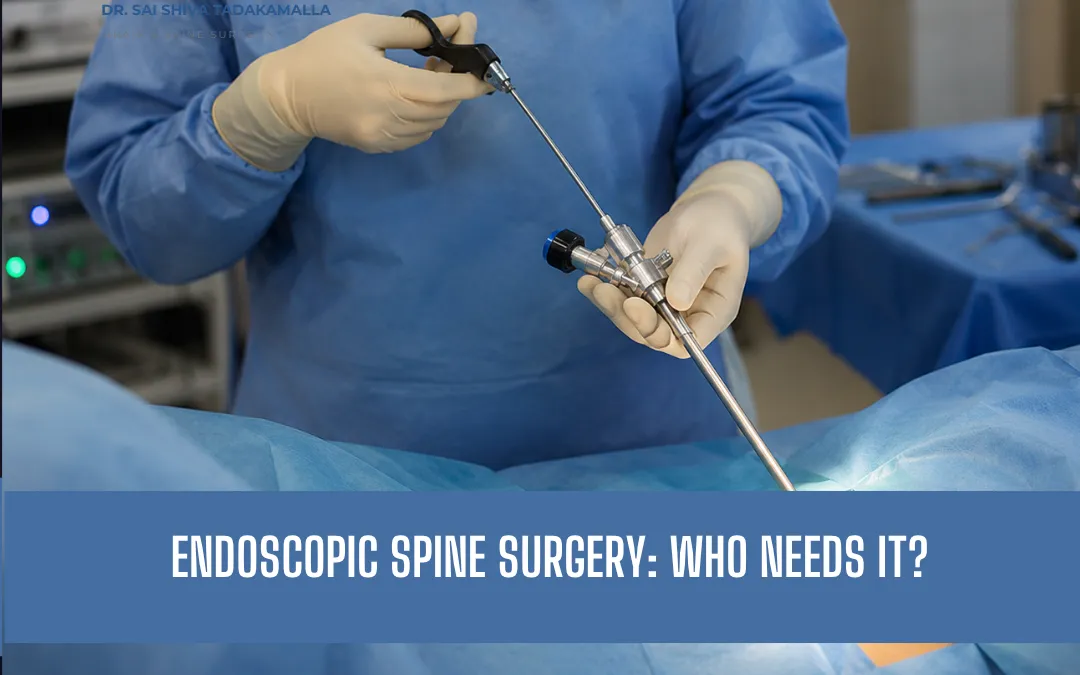
Endoscopic spine surgery is the keyhole version of spine surgery. A tiny camera goes in through one small cut, and the surgeon clears whatever is squeezing the nerve. It is mostly for people with a herniated disc, sciatica, or spinal stenosis. The kind with bad leg or arm pain, sometimes weakness, that physio and tablets just have not fixed.
According to Dr. Sai Shiva Tadakamalla, neurosurgeon in LB Nagar, Hyderabad,”Patients hear the words spine surgery and picture a long cut and months in bed. Endoscopic work is not that. Keyhole opening, day care most times, and the right patient is up and walking the same evening.”
Not every bad back needs it though. Whether you even qualify comes down to one thing. Reading your scan properly.
What Is Endoscopic Spine Surgery and How Does It Work?
The whole point of endoscopic spine surgery is reaching the spine through one small opening, not a long open cut. Here is how it works
- The endoscope goes in: A thin tube with a camera and light at the tip slides through an 8 to 10 mm cut, about a pencil’s width.
- The surgeon works off a screen: No staring into the wound. The camera feeds a monitor, and the instruments pass down the same tube.
- The pressure gets cleared: It trims the bit of disc that is pressing, or frees the trapped nerve, then comes back out.
- Muscle is spared, not cut: Tissue gets nudged aside. That one thing is behind the less bleeding, less pain, home-the-same-day part.
- Light anaesthesia, no hardware: Most run on local anaesthetic with sedation, and nothing is left inside for a routine disc.
It is one option inside the bigger world of spine surgery, picked when a small, targeted fix beats a full open operation.
Who Is the Right Candidate for Endoscopic Spine Surgery?
This is where it gets specific. Endoscopic surgery is not for everyone, and a few clear factors decide whether you are actually a fit.
- A single trapped nerve: A herniated or slipped disc pressing on one nerve root is the classic case for it.
- Stubborn sciatica: Leg pain that has not calmed after about 6 weeks of physio and medication.
- Foraminal stenosis: Where the nerve’s exit has narrowed and started pinching the root.
- Select repeat disc trouble: Recurrent problems after an earlier operation, in the right hands.
- Not the right call when: There is real instability needing fusion, wear spread across many levels, severe deformity, or large spinal tumours — in these cases, endoscopic surgery is not the right approach.
Old age on its own is not a dealbreaker. Plenty of patients past 65 do fine, simply because there is less tissue to climb back from. What actually decides it is your MRI sitting next to your symptoms. One nerve, one level, one clear target. That is the case this suits best.
Catching nerve trouble early counts for a lot. Same logic families use when they jump on the first signs of a mini stroke instead of waiting around for a second one.
Why Choose Dr. Sai Shiva Tadakamalla for Endoscopic Spine Surgery?
Dr. Sai Shiva Tadakamalla is a consultant brain and spine surgeon trained at PGIMER, Chandigarh, with an MCh in Neurosurgery and a post-doctoral fellowship. Minimally invasive and endoscopic spine work is right at the centre of what he does, alongside tougher disc, stenosis, and spinal tumour cases.
Surgeries happen at Gleneagles Aware Hospital, LB Nagar, with a dedicated neuro-ICU and care round the clock. Leg or back pain that just will not quit? Get the scan read by someone who does this every week
Struggling with persistent back or leg pain? Consult Dr. Sai Shiva Tadakamalla, Cerebrovascular and Brain Surgeon at Gleneagles Aware Hospital, LB Nagar, Hyderabad, to find out whether endoscopic spine surgery is the right minimally invasive treatment option for you.
Frequently Asked Questions
Is endoscopic spine surgery safe?
Yes, in the right case. It carries the usual surgical risks, but smaller incisions mean less blood loss and a lower infection risk than open surgery.
How long is recovery after endoscopic spine surgery?
Many patients go home the same day or the next. Light activity returns in about a week, with fuller recovery in three to four weeks for disc cases.
Does endoscopic spine surgery leave a scar?
Barely. The cut is around 8 to 10 mm, so most patients heal with a tiny mark and, in many cases, no stitches.
Can endoscopic surgery treat spinal stenosis?
Yes, certain types. Foraminal and some central stenosis respond well. Severe multi-level stenosis may still need an open approach.
References
- American Association of Neurological Surgeons (AANS) – Minimally Invasive Spine Surgery. https://www.aans.org/patients/conditions-treatments/minimally-invasive-spine-surgery/
- Endoscope-Assisted Spine Surgery: A Comprehensive Review (NCBI). https://www.ncbi.nlm.nih.gov/pmc/articles/PMC12285748/
Disclaimer: The information shared in this content is for educational purposes only and not for promotional use.