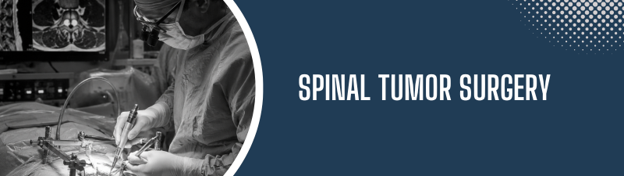
Surgical team performing spinal tumor surgery; banner reads 'Spinal Tumor Surgery' on a dark blue background.

Spinal Tumour Surgery in Hyderabad

A spinal tumour diagnosis is frightening. The words alone can make your mind race with questions about your movement, your independence, and what happens next. Take a breath. With the right surgeon and an early, careful plan, many spinal tumours can be treated safely.

If you are searching for an experienced neurosurgeon in Hyderabad, Dr. Sai Shiva Tadakamalla is a consultant neurosurgeon at Gleneagles Aware Hospital, LB Nagar, Hyderabad, with specialised training in spinal tumour surgery and minimally invasive spine procedures. He trained at PGIMER, Chandigarh, where he managed complex spinal cord tumours and has published research on the subject.

His approach is honest and measured. He studies your scans, explains exactly what he sees in plain language, and recommends surgery only when it genuinely helps. When surgery is the right step, he uses microsurgical techniques and intraoperative nerve monitoring to remove the tumour while protecting the spinal cord and the functions it controls.

Worried about a spinal tumour? Get a clear answer from Dr. Sai Shiva Tadakamalla.

What Is Spinal Tumour Surgery?

Spinal tumour surgery is the removal or treatment of an abnormal growth in or around the spinal cord, its coverings, or the surrounding vertebrae. The aim is to relieve pressure on the spinal cord and nerves, confirm the type of tumour through biopsy, and preserve neurological function such as movement, sensation, and bladder control.

Some spinal tumours are slow-growing and benign. Others are aggressive or have spread from cancer elsewhere in the body. The right treatment depends on the tumour’s type, size, exact location, and how it affects the nerves around it.

Surgery is carefully planned using MRI and advanced imaging so the surgeon can reach the tumour with the least possible disturbance to healthy spinal cord tissue.
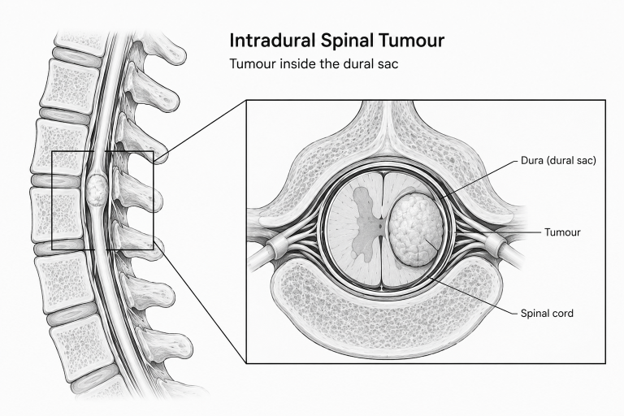
Cross-sectional spinal diagram showing an intradural tumor inside the dura, with an inset labeling the dura, spinal cord, and tumor.

Types of Spinal Tumours Treated by Dr. Sai Shiva Tadakamalla

Spinal tumours are grouped by where they sit in relation to the spinal cord and its protective covering. Dr. Sai Shiva Tadakamalla treats all three main types.
Brain tumour surgery in Hyderabad, surgical removal of abnormal brain growths

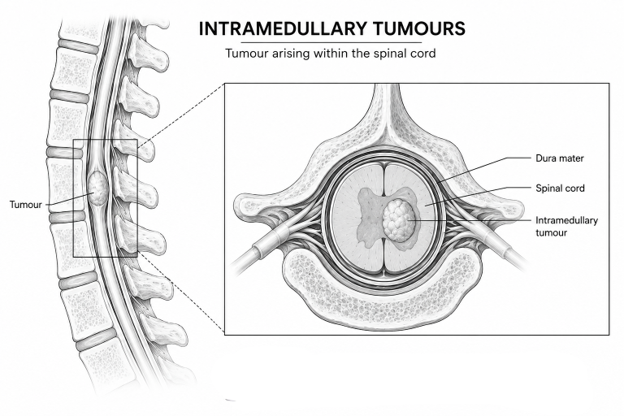
Intramedullary Tumours

These grow inside the spinal cord itself, such as ependymomas and astrocytomas. They are among the most delicate to operate on and need microsurgical precision with continuous nerve monitoring to protect cord function.
Cranial microsurgery in Hyderabad, high magnification precision brain surgery

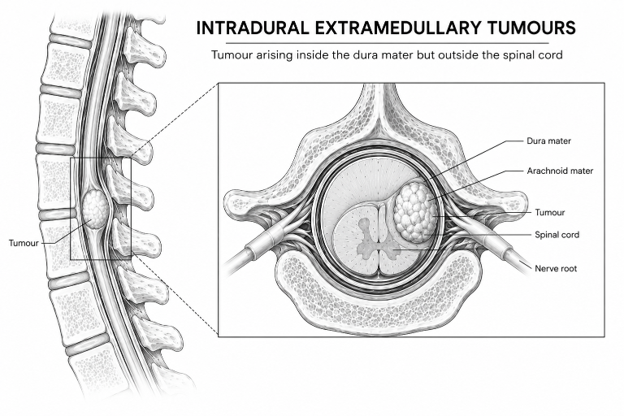
Intradural Extramedullary Tumours

These develop inside the protective covering of the cord but outside the cord itself. Meningiomas and schwannomas fall into this group. Many are benign and, when removed completely, offer excellent outcomes.
Awake brain surgery in Hyderabad, real time monitoring of speech and movement during surgery

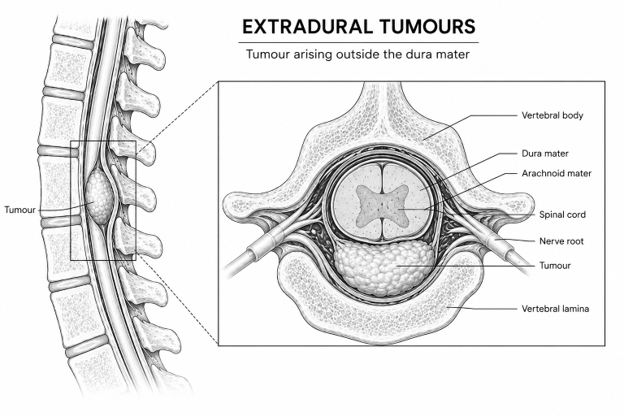
Extradural Tumours

These arise outside the dural covering, usually in the bones of the spine. Many are metastatic, meaning cancer has spread from another organ such as the lung, breast, or prostate. Surgery here often focuses on relieving cord compression and stabilising the spine.
Brain tumour surgery in Hyderabad, surgical removal of abnormal brain growths

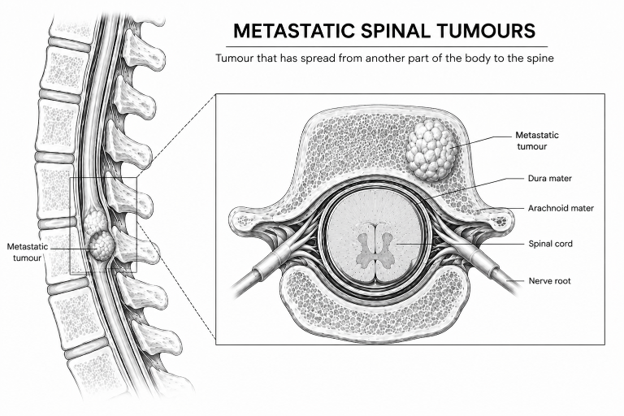
Metastatic Spinal Tumours

When cancer spreads to the spine, it can cause severe pain and threaten the spinal cord. Dr. Sai Shiva Tadakamalla performs decompression and stabilisation to protect function and improve quality of life, working alongside oncologists for further treatment.
Cranial microsurgery in Hyderabad, high magnification precision brain surgery

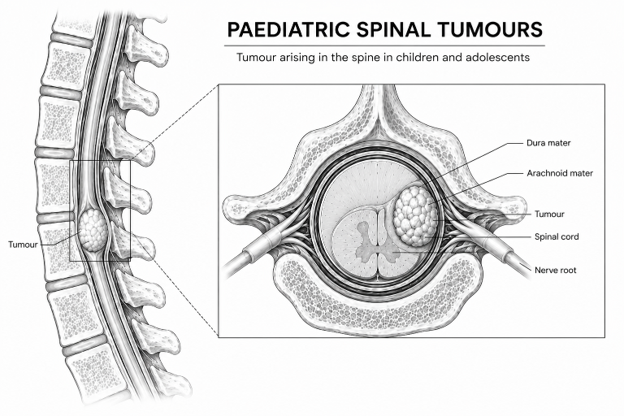
Paediatric Spinal Tumours

Children can also develop spinal cord tumours. Dr. Sai Shiva Tadakamalla treats paediatric spinal conditions and has presented research on quality of life in paediatric spinal cases at national conferences.

“With spinal tumours, the location matters as much as the tumour itself. My priority is always to remove what is dangerous while protecting the cord that controls how you walk, feel, and move.” – Dr. Sai Shiva Tadakamalla (underline – internal link to About Us), Brain & Spine Surgeon, Gleneagles Aware Hospital, LB Nagar, Hyderabad

Symptoms of a Spinal Tumour

Spinal tumour symptoms often build up slowly, which is why they are sometimes mistaken for ordinary back pain. Watch for these signs:

Back or neck pain that is worse at night or at rest
Pain that does not improve with usual treatment
Numbness, tingling, or a band-like tightness around the body
Progressive weakness in the arms or legs
Difficulty walking or loss of balance
Loss of bladder or bowel control (this needs emergency care)
Muscle wasting or clumsiness in the hands
Any new or worsening neurological symptom deserves prompt evaluation. Early diagnosis usually means safer surgery and better recovery.
Noticing weakness, numbness, or night-time back pain? Don’t wait it out. Schedule Your Assessment

When Is Spinal Tumour Surgery Recommended?

Dr. Sai Shiva Tadakamalla recommends surgery when the benefit of removing the tumour clearly outweighs the risk of waiting. Surgery is generally considered when:

The tumour is pressing on the spinal cord or nerves and causing symptoms
Bladder or bowel control is affected, which can be a surgical emergency
A tissue diagnosis (biopsy) is needed to plan treatment
There is progressive weakness, numbness, or loss of function
The tumour is growing on follow-up scans
The spine has become unstable and needs stabilising
Slow-growing, symptom-free tumours are sometimes monitored with regular scans instead of immediate surgery. Every case is assessed individually before any decision is made.

Surgical Approaches for Spinal Tumours

The right approach depends on the tumour type and location. Dr. Sai Shiva Tadakamalla uses modern, function-preserving techniques.

Brain tumour surgery in Hyderabad, surgical removal of abnormal brain growths

Microsurgical Tumour Resection

Using a high-powered surgical microscope, the tumour is separated from healthy spinal cord tissue and removed with precision. This is the standard for most intradural and intramedullary tumours.

Brain tumour surgery in Hyderabad, surgical removal of abnormal brain growths

Intraoperative Neuromonitoring

The function of the spinal cord and nerves is monitored in real time throughout surgery. This acts as an early warning system, helping protect movement and sensation while the tumour is removed.
Brain tumour surgery in Hyderabad, surgical removal of abnormal brain growths

Minimally Invasive and Endoscopic Approaches

Where suitable, smaller incisions are used to reach the tumour. This means less muscle damage, reduced blood loss, and a faster return to daily life.
Brain tumour surgery in Hyderabad, surgical removal of abnormal brain growths

Decompression and Spinal Stabilisation

When a tumour weakens the spine or compresses the cord, the affected area is decompressed and stabilised with titanium screws and rods to restore support and protect the nerves.

Recovery After Spinal Tumour Surgery

Recovery varies depending on the tumour type, its location, and your condition before surgery. Here is a general guide.

Tumour Type

Hospital Stay

Return to Light Activity

Full Recovery

Intradural Extramedullary (benign)

4 to 7 days

3 to 5 weeks

6 to 12 weeks

Intramedullary

5 to 10 days

4 to 8 weeks

Varies by case

Extradural / Metastatic

5 to 10 days

With oncology coordination

Varies by case

Tumour with Stabilisation

5 to 14 days

With physiotherapy guidance

3 to 6 months

This table is a general guide only. Your actual recovery will depend on your individual case.

Physiotherapy plays a major role in regaining strength and mobility. Dr. Sai Shiva Tadakamalla provides a clear follow-up and rehabilitation plan tailored to each patient, and coordinates with oncologists where further treatment such as radiation is needed.

“Recovery is a partnership. The surgery removes the tumour, but the weeks that follow, with the right rehabilitation, are what get you back on your feet. I stay involved through that whole journey.” – Dr. Sai Shiva Tadakamalla, Spine Neurosurgeon, Gleneagles Aware Hospital, LB Nagar, Hyderabad

Why Choose Dr. Sai Shiva Tadakamalla for Spinal Tumour Surgery in Hyderabad?

Consultant Skull Base, Cerebrovascular and Spine Surgeon | Neurosurgeon in Hyderabad Member, Panel of Medical Experts – Gleneagles Hospital 8 years of experience

Trained at India's Premier Neurosurgery Institute

Dr. Sai Shiva Tadakamalla completed his MBBS, MS, and MCh in Neurosurgery, with post-doctoral fellowship training at PGIMER, Chandigarh, where complex spinal tumour cases are managed daily.

Published Research on Spinal Tumours

His clinical work is backed by published research on spinal tumours, reflecting a deep, up-to-date understanding of the field.

Function-First Surgical Approach

Using microsurgery and real-time neuromonitoring, his focus is always on removing the tumour while protecting your ability to walk, feel, and move.

Care for Adults and Children

From elderly patients with metastatic spine disease to children with spinal cord tumours, Dr. Sai Shiva Tadakamalla has experience across all age groups.

Clear, Honest Communication

Patients describe him as warm, patient, and easy to talk to. Every diagnosis, surgical plan, and risk is explained in simple terms so you can make a confident, informed decision.
Male doctor in a white lab coat standing in a tidy clinic hallway, hands in pockets and smiling.
Take the first step toward answers and a clear plan. Talk to Dr. Sai Shiva Tadakamalla Today

FAQs

Are all spinal tumours cancerous?

No. Many spinal tumours, such as meningiomas and schwannomas, are benign and slow-growing. When removed completely, the outlook is often excellent. The exact nature is confirmed through imaging and, where needed, a biopsy.

Is spinal tumour surgery risky?

Every surgery carries some risk, but modern techniques like microsurgery and intraoperative neuromonitoring have made spinal tumour surgery much safer. The specific risks depend on the tumour’s type and location, and Dr. Sai Shiva Tadakamalla explains these clearly before surgery.

Will I be able to walk normally after surgery?

The goal of surgery is to protect and preserve your neurological function. Many patients regain strength and mobility, especially when the tumour is treated early before significant weakness sets in. Recovery is supported by a structured physiotherapy plan.

Do all spinal tumours need surgery?

No. Small, slow-growing tumours that are not causing symptoms may be monitored with regular scans instead. Surgery is recommended when the tumour causes symptoms, grows, or threatens spinal cord function.

Where can I consult Dr. Sai Shiva Tadakamalla for spinal tumour surgery in Hyderabad?

Dr. Sai Shiva Tadakamalla practises at Gleneagles Aware Hospital, LB Nagar, Hyderabad. You can call +91 9490033093 or use the contact form on this website to book an appointment.
Call Now Button