Lumbar Canal Stenosis in an Elderly Patient: Successful Surgical Recovery Under Dr. Sai Shiva Tadakamalla in Hyderabad
Doctor’s Name: Dr. Sai Shiva Tadakamalla
Patient’s Name: Laxminarsamma
Patient’s Age: 64
Gender: Female
Patient Feedback:
“I could not walk even a few steps without holding onto someone for two years. After the surgery with Dr. Sai Shiva, I was walking on my own. The tingling in my feet is gone. I wish I had come sooner.” – Laxminarsamma, Patient
Patient Background
Laxminarsamma, a 64-year-old housewife from Hyderabad, presented with two years of progressively worsening tingling and numbness in both feet, along with persistent back pain. Over time, her symptoms became severe enough that she could not walk without support, even for short distances.
Despite trying conservative treatments, her condition continued to decline. She was evaluated by Dr. Sai Shiva Tadakamalla, Consultant Skull Base, Cerebrovascular and Spine Surgeon at Gleneagles Aware Hospital, LB Nagar, Hyderabad.
Symptoms
Tingling and numbness in both feet for two years, gradually worsening
Persistent low back pain
Inability to walk without support, even for short distances
Progressive weakness in the lower limbs
Diagnostic Method
An MRI of the lumbar spine (LS spine) was performed, which revealed:
Lumbar canal stenosis at L3-L5 with significant nerve compression
Prolapsed Intervertebral Disc (PIVD) at the L4-L5 level
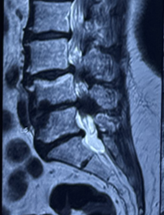
Sagittal MRI Lumbar Spine Showing Canal Stenosis at L3-L5
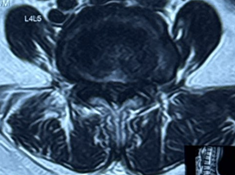
Axial MRI Showing Nerve Compression at L4-L5
Disease Diagnosed
Lumbar Canal Stenosis at L3-4, L4-5
Prolapsed Intervertebral Disc (PIVD) with bilateral nerve compression
Treatment Plan
Challenges:
The patient had been symptomatic for two years, with significant nerve compression requiring careful surgical planning
Bilateral foot symptoms indicated nerve involvement at multiple levels across L3-L5
The combination of canal stenosis and disc prolapse required both decompression and stabilisation
The patient's age and bone health needed to be factored into the fixation approach
Plan:
Dr. Sai Shiva Tadakamalla planned an L3-L5 canal decompression with spinal fixation, combined with an L4-L5 Posterior Lumbar Interbody Fusion (PLIF) to fully relieve nerve compression, stabilise the spine, and address the prolapsed disc at the L4-L5 level.
Surgery
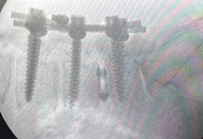
Laxminarsamma underwent L3-L5 canal decompression with fixation and L4-L5 PLIF as planned. The procedure involved removing the narrowed bone and tissue compressing the nerves across L3-L5, placing instrumentation (screws and rods) to stabilise the spine, and replacing the prolapsed L4-L5 disc with a bone graft and cage to fuse the segment.
The nerve roots were fully decompressed. The patient tolerated the surgery well with no intraoperative complications.
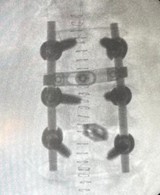
Post-Operative X-Ray AP View Showing L3-L5 Fixation and L4-L5 PLIF
Post-Operative X-Ray Lateral View Showing L3-L5 Fixation and L4-L5 PLIF
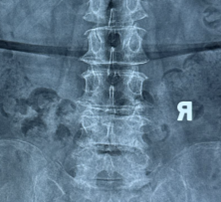
Pre-Operative AP X-Ray Showing Lumbar Spine Alignment
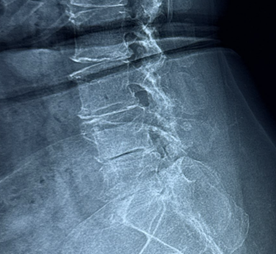
Pre-operative lateral X-ray of lumbar spine showing spinal canal narrowing at L3-L5, evaluated by Dr. Sai Shiva, neurosurgeon in Hyderabad
Post-Surgery Guidelines
- Laxminarsamma was monitored closely post-operatively for observation and stabilisation
- Managed with antibiotics, pain relief medication, and supportive care
- Showed immediate and significant improvement in symptoms from day one after surgery
- Wound healing was healthy with no signs of infection
- Advised on activity modifications, spine care, and gradual return to daily routine
- Physiotherapy recommended for strengthening and long-term spine health
Outcome
At the time of discharge, Laxminarsamma was stable and comfortable. The tingling and numbness in both feet had improved significantly. Most importantly, she was able to walk without support for the first time in two years. Neurological function in her lower limbs was intact. The surgical wound was clean and healing well.
This case demonstrates that in elderly patients with long-standing lumbar canal stenosis and disc prolapse, timely surgery can restore independence, relieve chronic nerve compression, and deliver meaningful improvement in quality of life.
Long-Term Care
With regular follow-ups and guided physiotherapy, Laxminarsamma is expected to continue recovering well and return to her normal daily routine. Dr. Sai Shiva advised her to maintain a healthy posture, take a calcium and vitamin D-rich diet for bone strength, avoid heavy lifting and extreme bending during the initial recovery phase, and stay consistent with her rehabilitation exercises to support long-term spine health.
Disclaimer: The information shared in this content is for educational purposes only and not for promotional use.