

Most people have had a headache bad enough to make them stop what they were doing. Most of the time, it passes. You drink some water, rest for an hour, and carry on.
But some headaches keep coming back. Some start suddenly and feel nothing like any headache you have had before. Some throb only on one side. Some press like a band around your head. Some hit the back of the neck and travel upward.
These differences are not random. Where your headache is located – and how it feels – often points directly to what is causing it. And in some cases, the location is a signal that something more than tension or stress is going on inside the brain.
This blog by Dr. Sai Shiva Tadakamalla, neurosurgeon in LB Nagar, Hyderabad, breaks down the most common headache areas, what they typically mean, and when the pain you are feeling needs more than a tablet.
Your head has been hurting for weeks. The tablet works for a few hours, then it comes back. That cycle is not treatment — it is delay. Get to the bottom of it.
Why Headache Location Matters
Not all headaches come from the same place or the same cause. The brain itself does not have pain receptors – but the blood vessels, meninges (the lining around the brain), muscles, and nerves of the skull and neck do. When any of these structures are irritated, inflamed, compressed, or under pressure, you feel it as pain – and where you feel it depends on which structure is involved.
Paying attention to the location, the pattern, and the timing of a headache gives both patients and doctors a starting point. A one-sided pulsating headache that comes with nausea is a very different problem from a sudden, severe headache at the back of the head that comes on in seconds.
The location is not a diagnosis. But it is a clue that should not be ignored.
“Most patients come to me after months of self-medicating. The headache location was telling them something the whole time — they just did not know how to read it. That is exactly what a proper evaluation is for.”
-Dr. Sai Shiva Tadakamalla, Consultant Cerebrovascular and Brain Surgeon, Gleneagles Aware Hospital, LB Nagar, Hyderabad
Headache Areas and What They Commonly Indicate
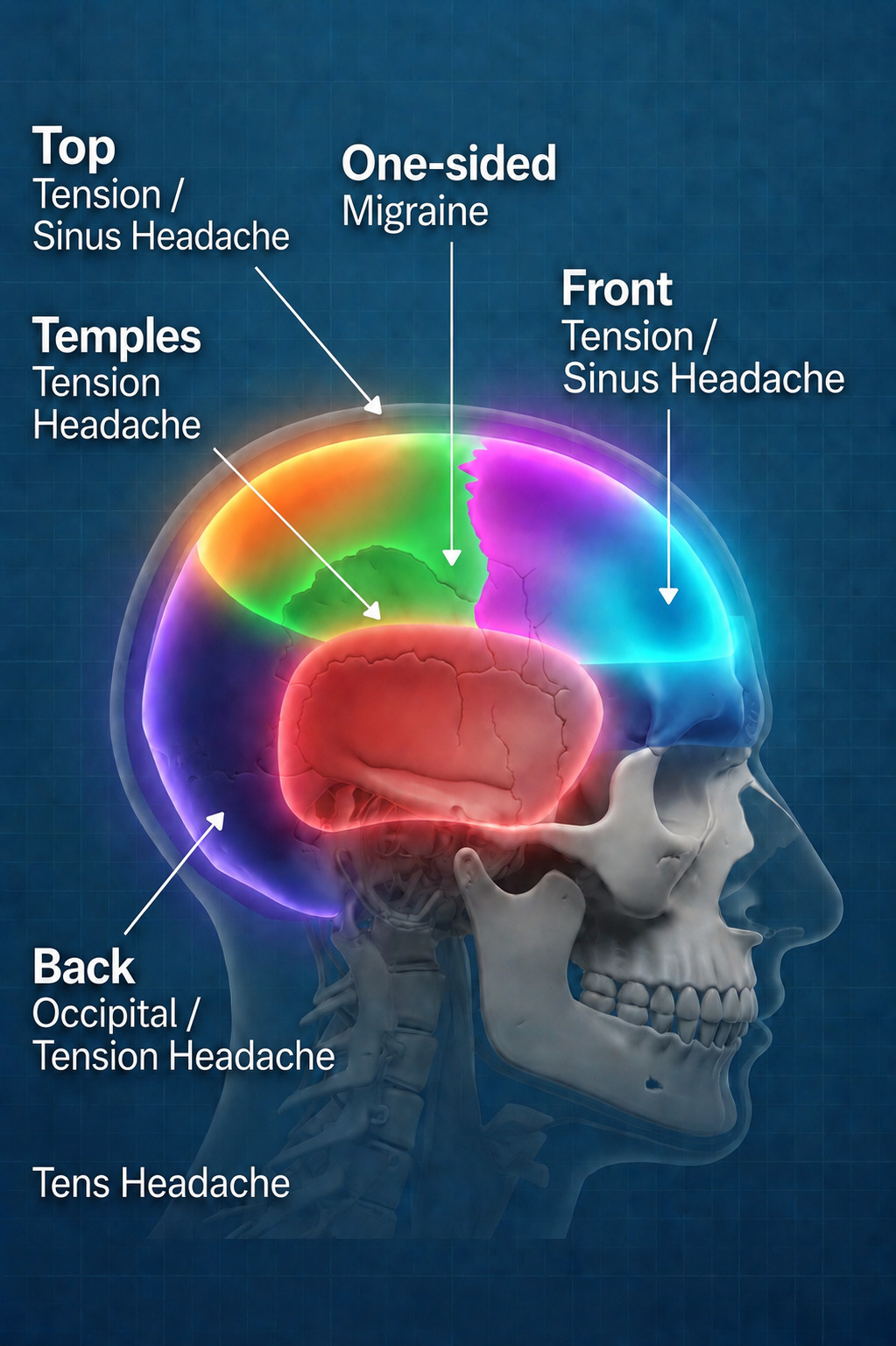
Forehead and Behind the Eyes
Headaches felt across the forehead or behind the eyes are among the most common. In most cases, these are tension-type headaches – caused by prolonged screen time, stress, poor posture, or disrupted sleep. The pain is usually dull, pressing, and present on both sides.
However, pain behind one or both eyes that is severe, accompanied by redness of the eye or blurring of vision, should not be dismissed. This can indicate raised intraocular pressure or, in some cases, raised intracranial pressure – both of which need prompt evaluation.
Sinus-related headaches also concentrate in the forehead and around the nose bridge, typically worsening when you bend forward or wake up in the morning.
When to be concerned: Headache behind the eyes with sudden vision changes, vomiting, or confusion requires same-day evaluation.
Temples (One Side or Both)
Temple headaches that throb and occur repeatedly – especially with sensitivity to light, nausea, or aura (visual disturbances before the headache) – are classic features of migraine.
Migraine is not just a bad headache. It is a neurological condition that affects brain signalling, and in patients who have frequent episodes without treatment, it can reduce quality of life significantly. It is also more common than most people realise – estimates suggest it affects nearly 15% of the Indian adult population.
In patients above 50 with new-onset one-sided temple pain, jaw ache while chewing, and scalp tenderness, a condition called temporal arteritis (inflammation of the artery running along the temple) should be considered. This is a medical emergency because it can rapidly affect vision.
When to be concerned: Temple pain in older adults that is new, persistent, and comes with scalp tenderness or jaw pain needs urgent blood tests and specialist review.
Back of the Head and Neck (Occipital Region)

Pain at the base of the skull, radiating up from the neck toward the back of the head, is called an occipital headache. This is extremely common in people with cervical spine problems – disc issues, nerve compression, or muscle tension from poor posture.
But the back of the head is also where one of the most dangerous types of headache presents. A sudden, explosive headache – patients often describe it as “the worst headache of my life” – that starts at the back of the head is a classic sign of a subarachnoid haemorrhage, most often caused by a ruptured brain aneurysm.
This type of headache reaches maximum intensity within seconds. There may be neck stiffness, vomiting, and brief loss of consciousness. It is a neurological emergency.
When to be concerned: Any sudden, severe headache at the back of the head – especially one unlike previous headaches – should be treated as an emergency. Do not wait. Go to hospital immediately.
“A thunderclap headache at the back of the head is the one I never want a patient to wait on. By the time they decide it is serious enough to come in, the window for the best outcome may already be narrowing.”
– Dr. Sai Shiva Tadakamalla, Consultant Cerebrovascular and Brain Surgeon, Gleneagles Aware Hospital, LB Nagar, Hyderabad
One-Sided Head Pain (Cluster Headaches)
Cluster headaches are severe, one-sided headaches that occur in episodes – multiple times a day for weeks, then disappear entirely for months. The pain is typically centred around one eye and is described as burning or stabbing. The eye on the affected side may water, the eyelid may droop, and the nostril may run.
These are among the most painful headache conditions known. They are often misdiagnosed as sinus problems or dental pain for months before a correct diagnosis is made.
Unlike migraine, cluster headaches cannot be slept off – patients often pace the room or cannot keep still during an episode.
When to be concerned: Any new one-sided headache with eye symptoms, nasal discharge, or extreme severity warrants neurological evaluation.
Top of the Head
Headaches felt at the crown of the head are less common but are associated with tension headaches, hormonal fluctuations, and in some cases, referred pain from neck and shoulder muscle tightness.
In patients who have had recent head trauma, new pain localised to the top of the skull – especially if it worsens on lying down or straining – may be related to raised intracranial pressure and should not be self-managed.
Headaches That Are Always a Red Flag
Regardless of location, certain features in a headache make it medically urgent. These are called “red flag” headaches and they include:
- Thunderclap onset – pain that reaches peak intensity within 60 seconds of starting
- Headache with fever and neck stiffness – possible meningitis
- Headache after a head injury – even hours or days later
- Progressively worsening headache over days or weeks with no clear cause
- Headache with neurological symptoms – weakness, speech difficulty, confusion, vision loss
- New headache in a patient above 50 with no prior headache history
- Headache that wakes you from sleep consistently
These patterns require imaging and specialist evaluation, not a wait-and-see approach. Some of these headaches are caused by brain tumours, bleeding inside the skull, or cerebrovascular conditions – all of which are treatable when caught early.
If even one item on that list sounds familiar, this is not the moment to schedule it for later. Brain conditions caught early respond far better to treatment than those caught under emergency conditions.
When Should You See a Neurosurgeon for a Headache?

Most headaches are benign. But a significant number of people live with recurring or worsening head pain for months, managing it with over-the-counter tablets, without ever understanding what is causing it.
If your headaches are becoming more frequent, more severe, changing in character, or now coming with any neurological symptoms – even mild ones – a proper evaluation is worth having. An MRI, a thorough clinical history, and a specialist’s assessment can rule out the serious causes and give you a clear picture of what is actually going on.
For patients in Hyderabad, consulting a cerebrovascular and brain specialist like Dr. Sai Shiva Tadakamalla at Gleneagles Aware Hospital, LB Nagar, can help identify whether your headache has a neurological cause that needs attention – before it becomes something harder to manage.
You do not have to wait for a headache to become an emergency before seeking one.
“The headache that concerns me most is the one the patient has been ignoring for three months because the tablet worked. The tablet managing the pain is not the same as the cause being treated. I have seen brain tumours and aneurysms present as headaches that patients called ‘just stress.’ Location and pattern matter. Get it checked.”
– Dr. Sai Shiva Tadakamalla, Consultant Cerebrovascular and Brain Surgeon, Gleneagles Aware Hospital, LB Nagar, Hyderabad
Frequently Asked Questions
Can the location of a headache tell you what is causing it?
Yes, to a significant extent. The area where you feel the pain — forehead, temples, back of the head, or one side — often points to a specific type or cause. However, location alone is not a diagnosis. A specialist evaluation is needed to confirm the underlying cause.
Which headache location is most dangerous?
A sudden, severe headache at the back of the head that reaches peak intensity within seconds is considered the most medically urgent. This pattern can indicate a ruptured brain aneurysm or bleeding around the brain and requires emergency care immediately.
What does a headache behind the eyes mean?
It is commonly associated with tension headaches, eye strain, or sinus pressure. However, if it is severe, sudden, or accompanied by vision changes, it may indicate raised intracranial pressure and should be evaluated promptly.
Are cluster headaches and migraines the same thing?
No. Both cause significant pain but they are different conditions. Migraines typically last hours to days and are often accompanied by nausea and light sensitivity. Cluster headaches are shorter, extremely intense, one-sided, and occur in grouped episodes over weeks.
When should a headache be treated as a medical emergency?
Seek immediate care if your headache is sudden and explosive, follows a head injury, comes with fever and neck stiffness, causes weakness or speech difficulty, or is unlike any headache you have had before.
References
- Mayo Clinic. Headaches: Causes. Available at: https://www.mayoclinic.org/symptoms/headache/basics/causes/sym-20050800
- Cleveland Clinic. Headache: Types, Causes, Symptoms & Treatment. Available at: https://my.clevelandclinic.org/health/diseases/9639-headaches
- American Migraine Foundation. Understanding Migraine. Available at: https://americanmigrainefoundation.org/resource-library/understanding-migraine/
- National Institute of Neurological Disorders and Stroke. Headache Information Page. Available at: https://www.ninds.nih.gov/health-information/disorders/headache
- World Health Organization. Headache Disorders. Available at: https://www.who.int/news-room/fact-sheets/detail/headache-disorders
Disclaimer: The information shared in this content is for educational purposes only and not for promotional use.